Passing executions
Local run on November 10, 2026, commit aec177d0. Zero failures, 26 ignored. Includes the CLI suite repeated for both executables; not a count of unique tests.
Lodeward / governance system
Connect context across sessions. Check commands before execution. Review what your agent learns before a lesson becomes a rule.
Explore the system ↗01 / The purpose
Lodeward connects persistent memory and execution rules to the AI client. The MCP server handles queries; hooks act at workflow checkpoints. A learned lesson becomes guidance only after your approval.
02 / Workflow
Select a stage.
Every decision is readable, even without 3D.
A hook checks command patterns before execution. Policy can allow, request confirmation or block. The detector is lexical: it cannot recognize every attack and does not replace a sandbox.
A recorded lesson enters quarantine. It should not guide the agent while awaiting review. Graph observations and approved lessons follow different paths.
You review the lesson and choose to approve or reject it. Change proposals have a separate cycle: approval, application and rollback. This page does not simulate human authorization.
The MCP client queries the graph and approved lessons. Hooks deliver selected context; the compaction archive preserves material for retrieval. Better retrieval and lower usage remain hypotheses to measure.
Explanatory demonstration. It does not execute commands, access your memory or approve lessons. Real integration depends on hooks installed in the client.
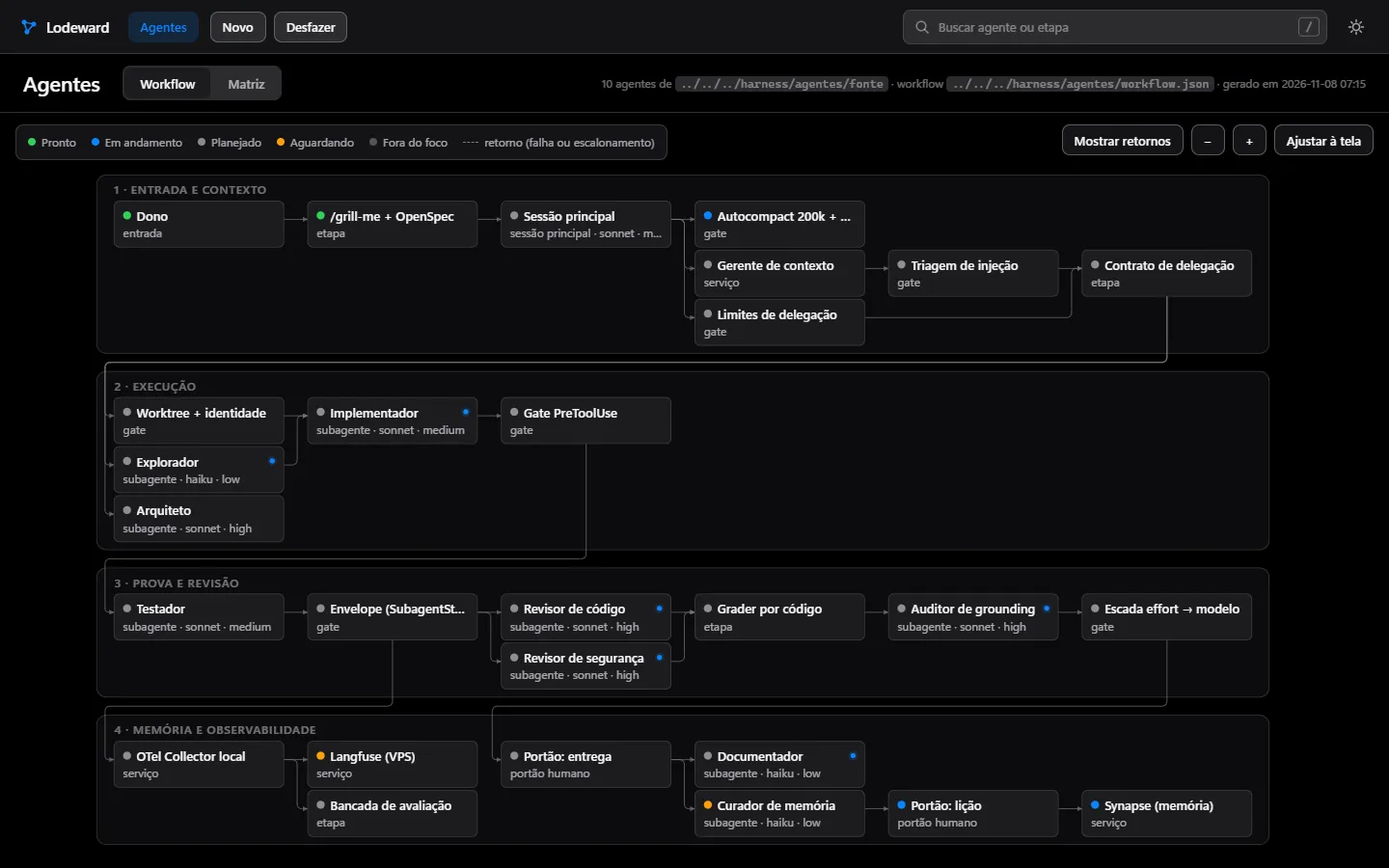
Interface / actual capture
Input. Execution. Review. Memory.
See relationships and decision points in the integrated harness Agents page.
03 / Evidence
Historical record
November 9–10, 2026
Scope stated for every result
Local run on November 10, 2026, commit aec177d0. Zero failures, 26 ignored. Includes the CLI suite repeated for both executables; not a count of unique tests.
tools/list matched the captured 70e415e8 baseline in eight scenarios. Schemas, descriptions and array order were preserved. The baseline was not rerun in that round.
Quarantine, approval, rejection, restart and project filters in an isolated demonstration with synthetic data. This does not prove universal isolation or quality gains.
Assessment of November 9, 2026. Reproducible installation passed; the full V1–V8 rubric still has gaps. Rename validation does not promote the product to N3.
These figures belong to the stated commit and protocol. They do not validate the latest version. Read sources and hashes ↗
04 / Project status
The engine runs and the lesson cycle has been demonstrated. General retrieval superiority, long-session savings and public readiness remain unproven.
Retrieval: 457 versus 456 in 470 queries, interpreted as a tie with BM25. Long sessions: ratio 1.2133 (95% CI 1.1039–1.3397), about 21% more usage in 45 pairs. Reduced context: 30 of 40 answers versus 40 of 40 with full context. Model tests used partial isolation. These are historical results, not rerun by this page.
Lodeward continues the SynapseEngine project. Compatibility preserves the synapse alias and existing MCP contracts. A new identity does not mean every technical gap has been resolved.
Organic form and brain data visualization: Brain.space / TOMMY&YOU — Awwwards, including cursor interaction and the technology page composition. The studio case study connects human form with precise data. Rendered in Three.js with original illustrative connections. Brain model: BodyParts3D, © The Database Center for Life Science, under CC BY 4.0, converted by OrganUI and adapted for this page. Credits and modifications. Synapses represent software stages, not live data.